How to Plan a Wedding: The Complete 2026 Guide
Planning a wedding takes 12–18 months and costs $28,000–$35,000 on average for 80 guests in the US. This guide walks you through it in eight clear steps from engagement to the big day — with realistic US budgets, a timeline for any situation, and a downloadable checklist.
In this guide
1. When to start planning?
The honest answer: as soon as the proposal is accepted. Not because wedding planning has to be stressful — but because the best venues, photographers, and caterers are booked 12 to 18 months in advance. Starting early buys you choice. Starting late buys you compromises.
But "starting early" doesn't mean deciding everything at once. It means setting a clear framework and making the two or three decisions that determine everything else.
The three realistic planning scenarios
Depending on how much time sits between the engagement and your target date, your roadmap looks different. These three scenarios cover over 90% of US weddings:
18+ months
You have time for everything — including pivots along the way. Popular for couples doing destination weddings or those with a specific venue on a long waitlist.
In the first 3 months:
- Set the budget framework (see step 2)
- Rough guest list (wishlist version, not final)
- Research 2–3 target dates and venue candidates
- Capture a wedding vision — style, mood, vibe
What you don't need to decide yet: dress, florist, music. Anything tied to fashion or season is better chosen 9–12 months out.
12 months
The most common case — and the best balance between enough choice and a manageable planning marathon. If you want a classic summer/fall wedding date, this is the runway you need.
In the first month:
- Budget + rough guest count (two numbers that drive everything else)
- Date range + 5–10 venue candidates contacted
- Approach your wedding party — they're your planning team
In months 2–4:
- Book venue, pay deposit
- Secure photographer, caterer, and officiant
- Send save-the-dates (month 4–5)
If you nail the first four months, the rest gets noticeably easier. Most stressful weddings aren't stressful because of too little time — they're stressful because the first months got lost.
6–9 months
Doable — but only with clear priorities and willingness to accept plan B at top vendors. Popular for smaller weddings (under 40 guests) or when the date is fixed for personal reasons.
In the first week:
- Lock the date, everything else follows
- Streamline venue search: 3 candidates, fastest response wins
- Photographer in parallel — same logic
For express weddings: let go of perfection. A beautiful wedding with small compromises on detail X is better than a 12-month drama that exhausts everyone involved.
The most common trap when starting
Over 70% of couples lose the first 4–6 weeks to Pinterest research without decisions. Understandable (inspiration is endless) — but it pushes the critical decisions back.
My advice: set yourself one Pinterest hour per week for inspiration, but make the two anchor decisions (budget + guest list) in the first week. Everything else follows from there.
2. Set a realistic budget
Before every other decision comes this one: how much are we willing to invest? Not "what can we afford" — that's a different question. But: what's it worth to us, and where is the money coming from? This answer reshapes everything that follows.
US averages by wedding size
Real numbers from the past 2 years — based on industry surveys and US venue data. The range is wide because style choices, region (coastal/urban vs. rural), and season have massive impact:
| Guest count | Budget range (USD) | Per guest |
|---|---|---|
| 20–30 (intimate) | $5,000 – $20,000 | ~ $250 – $700 |
| 40–60 (small) | $15,000 – $40,000 | ~ $400 – $700 |
| 80–120 (standard) | $28,000 – $55,000 | ~ $350 – $500 |
| 150+ (large) | $45,000 – $120,000+ | ~ $300 – $800 |
The 12 budget categories and typical allocation
If you set 100% as the total budget, a realistic split looks like this:
- Venue rental: 15–20%
- Catering (food + drinks): 30–40% — the biggest line item
- Photography + video: 10–15%
- Attire (dress + suit + shoes): 8–12%
- Rings: 3–5%
- Florals + decor: 5–8%
- Music (DJ or band): 3–5%
- Invitations + stationery: 1–3%
- Cake + desserts: 1–3%
- Officiant: 1–2%
- Transport + lodging: 2–4%
- Reserve (unforeseen): 5–10% — always plan this in
Five real budget levers (no "fold your own napkins" nonsense)
What actually saves money are big structural decisions, not DIY detail work:
- Off-season wedding (November–March): Venue prices 20–40% lower, top vendors available. Candles, fireplace, intimate vibe — works beautifully.
- Weekday instead of Saturday: Friday saves 20–30% at venues and vendors, Thursday even more. Guests often turn it into a long weekend.
- Cocktail-style reception instead of seated dinner: Cuts catering costs in half for the same guest count. Modern and elegant.
- Seasonal flowers instead of imports: A peony wedding in February costs 3× more than in May. Ask your florist "what's in season right now" — it becomes your style direction.
- DJ instead of live band: Saves $2,000–$5,000. Live band for 30 minutes during cocktail hour plus DJ for the rest = best compromise at most budgets.
3. Choose a date and venue
These two decisions run in parallel — not sequentially. The reason: your target venue is often booked on your target date, and your target date doesn't match any of the available venues. Keeping both flexible gets you there fastest.
Season trade-offs for US weddings
Spring (April–May)
Mild, often sunny, fresh flower season. Pro: Best floral prices, relaxed venues. Con: Weather uncertainty, outdoor risk.
Summer (June–August)
Peak wedding season. Pro: Best weather odds, outdoor cocktail hour works. Con: Highest prices, top vendors booked, often hot (consider dress comfort).
Fall (September–October)
Golden light, milder temps. Pro: Stylish atmosphere, great photo light. Con: Increasingly popular, barely cheaper than summer now.
Winter (November–March)
Intimate, fireplace, candles, snow-photo magic. Pro: 20–40% cheaper, best availability, unique atmosphere. Con: Travel risk, no outdoor.
Venue types and price reality
Rental for 80 guests, excluding catering:
- Restaurant with private room: $0–$2,000 (often free with minimum spend). Pragmatic, often beautiful, catering handled automatically. Best for small weddings.
- Hotel with event space: $1,500–$5,000. Convenient (guests stay on property), service is dialed, but style can feel generic.
- Barn / vineyard / historic venue: $3,000–$10,000+. High wow-factor, but catering often required-vendor, less flexibility.
- Event space / loft / industrial: $2,000–$6,000. Maximum flexibility, choose your own caterer, modern setting. You build everything — including bathroom logistics.
- Outdoor (garden, beach, estate): $1,000–$4,000. Magical with good weather. Plan B MUST be in the contract — otherwise you're scrambling on the day asking if all 80 guests fit in your living room.
What must be in the venue contract
Before paying the deposit, check these eight points in writing:
- Time window: setup starts when, breakdown ends when (same day or next morning?)
- Cancellation terms: what happens with rescheduling, reduction, full cancellation
- Minimum spend / minimum guest count: penalty fees if below
- External catering allowed? Or is in-house required?
- Corkage fee: if bringing own wine/spirits
- Weather plan B: which indoor space, at what weather trigger
- Music end time: 11 PM, midnight, later?
- Cleanup: included or extra cost?
4. The guest list — and why it drives everything
Guest count is the central lever of all wedding planning. It determines venue size, catering budget, number of chairs, invitations, seating chart effort, even photo composition. Get this wrong and everything is off.
The A/B/C method
Structure your first list in three tiers instead of making "yes/no" calls from the start:
- A-list: Definitely attending (parents, siblings, best friends) — usually 20–40 people.
- B-list: Should be invited (extended family, good friends) — another 20–60 people.
- C-list: Would be nice (coworkers, distant relatives, plus-ones) — remainder.
Set your total cap first (e.g., "max 100 guests"), then fill A completely, B generously, C only if space remains. This makes declines easier: "we had to limit to closest circle" works, "you were on the C-list" doesn't.
Hard questions, answered clearly
- Kids invited? Adults-only is increasingly accepted, communicate early on the save-the-date. Middle ground: kids under 12 with dedicated childcare ($200–$500 for the evening = huge comfort win for all parents).
- Plus-ones? Rule of thumb: only for married couples and partners together 1+ year. Single plus-ones ("bring someone") are rare today and blow up budgets.
- Ex-partners / complicated family? If one guest ruins the vibe for another important guest, the answer is simple: the more important guest wins. Not personal, just protecting your day.
- Destination wedding? Rule of thumb: 60–70% of invited international guests will RSVP yes. Plan hotel blocks and travel info early.
Avoiding parent conflict
Most common guest-list fight: parents want to invite their friends, the couple wants a smaller wedding. The clean solution: three pre-agreed parent slots.
- Per set of parents, X freely chosen guests (e.g., 10) — no further discussion on these.
- Anything beyond requires justification and mutual agreement.
- Whoever contributes more financially doesn't automatically get more slots — money is negotiated separately.
5. Dress, suit, rings
The most personal purchases of the wedding. Sequence matters because each leads to the next: dress first (longest lead time), then rings (matched to style), then suit (coordinated with dress).
Wedding dress — timing and US sources
Plan 9–12 months before the wedding for your first fitting. Sounds early, but: dress lead time is 4–6 months from order, plus 2–3 alteration appointments. Starting late means buying off-the-rack — which can work, but limits choice dramatically.
Three paths to the dress in the US:
- Bridal boutique: $1,500–$6,000. Classic, with consulting, all alterations on-site. Appointments often booked 4–8 weeks ahead, especially in major cities.
- Designer direct: $3,000–$15,000+. Unique, often premium labels, personal consulting, long lead times.
- Online (with caution): $200–$800. Works, but: alterations at local tailor often $300–$600, possible fabric surprises. Only recommended for experienced buyers or backup dress.
Suit and shoes
Suit is chosen after the dress so styles align (classic vs. casual, tuxedo vs. linen). Custom suit ordered 6 months out, off-the-rack 3 months is enough. Shoes a few months before — and definitely break them in. Blisters on the wedding day are preventable.
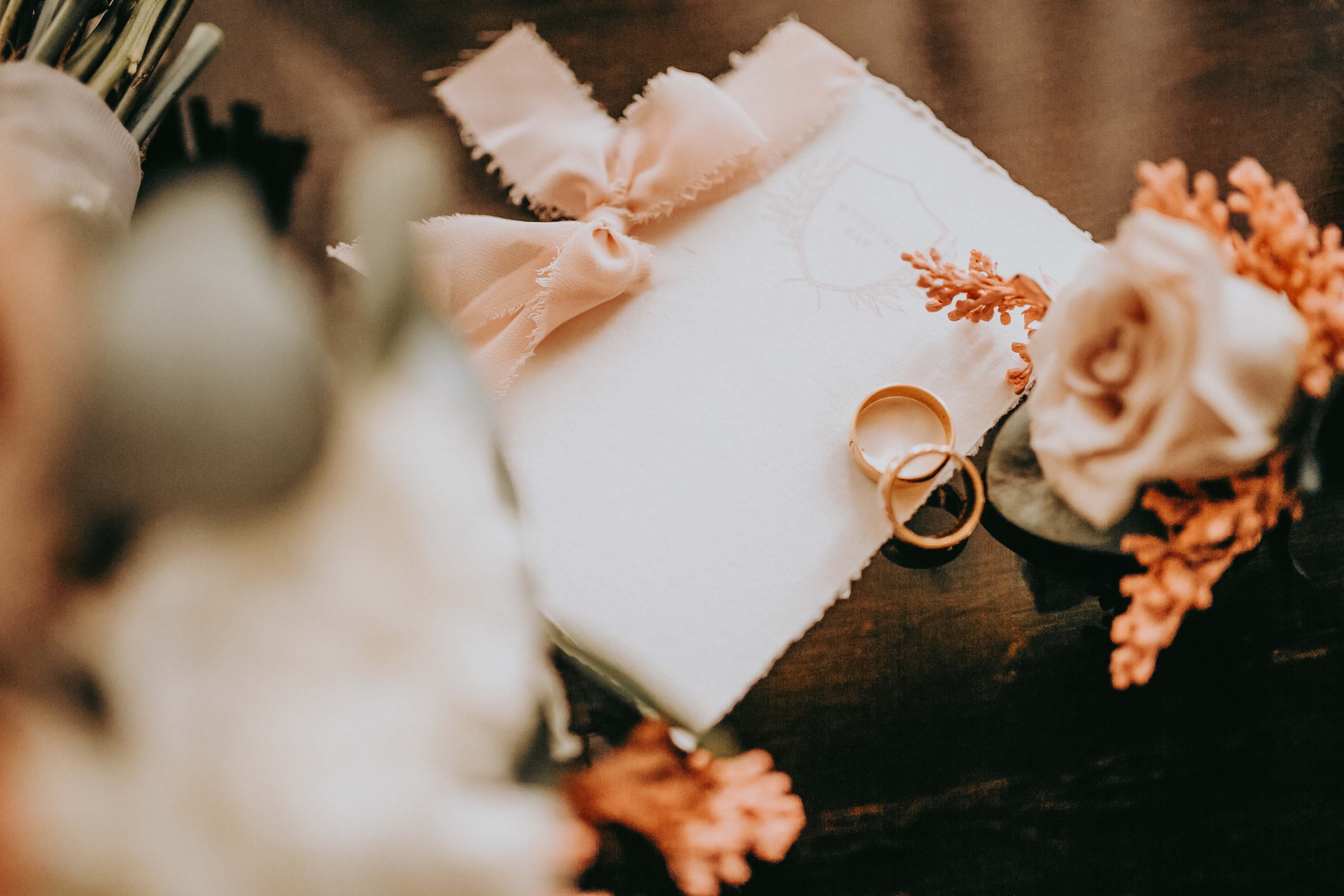
Wedding bands — material, lead time
Plan 4–6 months before the wedding for ring selection. US jewelers typically work on order (6–8 weeks lead time), custom designs take longer. Three material options:
- Gold (yellow/white/rose): Classic, resizable, robust choice.
- Platinum: Harder and more scratch-resistant than gold, but 30–50% more expensive.
- Titanium / palladium: Modern material, lighter, often more affordable.
6. Book your vendors — photographer, catering, music
Order of booking by competition pressure: whoever sells out fastest gets booked first. In the US that means: photographer before caterer before music before florist. Top photographers in major markets are booked 12–18 months ahead for peak season Saturdays.
Photographer — what really matters
Style is personal, but three things are objectively checkable:
- See full wedding galleries (not just highlights): What does a full wedding look like, not just the 20 best shots?
- Backup setup: Two cameras on hand? Second shooter? Memory card duplication?
- Delivery time + format: When do photos arrive? How many? Print rights included?
US price range: $1,500 (emerging pros) to $5,000 (experienced specialists) for 8 hours + edited gallery. Under $1,000 = risk. Over $6,000 = style statement.
Catering — buffet vs. plated vs. family-style
- Plated (3-course menu): $80–$200 per person. Classic, personal, but service-intensive (more staff needed).
- Buffet: $50–$150 per person. Less staff, more choice for guests, more casual.
- Family-style (shared plates): $70–$180 per person. Connects hands and tables, very on-trend, medium logistics.
- Cocktail-style reception (instead of dinner): $35–$90 per person. Halves catering budget, works great for smaller or afternoon weddings.
Bar separate or included? Get it in writing, otherwise surprises. For wine service: 1 bottle per 2 people for a 3-course dinner is the rule of thumb.
Music — DJ, band, or combo?
- DJ: $1,000–$3,000. Max flexibility (any song request works), great dance floor with mixed music taste. Best choice for most weddings.
- Live band: $3,000–$8,000. Atmosphere, wow-factor, but limited repertoire, less danceable for younger generation.
- Combo: Live band for cocktail hour / first dance ($1,500–$3,000), DJ for the reception ($800–$1,500). Most popular compromise in 2026.
Florist + other vendors
Florist booked 6 months ahead, with clear budget and seasonal openness. Wedding cake 3 months ahead (bakery or pastry chef), hair & makeup 4 months out with a trial 2 weeks before the wedding.
7. Save-the-dates and invitations
Two sendings, clear job separation: save-the-date locks the date in guests' calendars, the invitation delivers all the details. Don't mix them.
Save-the-date — timing and content
Send 6–8 months before the wedding, for destination weddings even 10–12 months ahead. What to include: date, city/region, names, "invitation to follow". What NOT to include: venue details, schedule, dress code — that's the invitation's job.
Invitation — timing and content
Send 8–10 weeks before the wedding, with RSVP deadline 3–4 weeks before the day. What belongs in:
- Date, time (ceremony start, reception start if separate), venue address
- Dress code (if any) — be specific, "elegant" helps no one
- Kids yes/no
- RSVP method + deadline (card, email, online form)
- Notes: gifts (registry vs. cash), allergies, hotel recommendations
- Day-of emergency contact (often maid of honor)
Digital vs. print
Digital is fully accepted in 2026 and 80–90% cheaper. Print is still the tactile "wow moment", especially for older relatives. Hybrid works well: save-the-date digital, invitation in print for the top 30 guests, rest by email. Saves money and time without style loss.
RSVP tracking
Real work begins after sending. Expect 30–40% of responses only after the first reminder. Use a simple tracking system (spreadsheet works — or a tool like WeddingFlow that links RSVP status with seating chart and catering). Rule of thumb:
- Local guests: ~90% yes rate
- Domestic travel: ~75% yes rate
- International: ~50–60% yes rate
8. Wedding day logistics
The final 6 weeks are no longer planning weeks, but detail weeks. Anyone making big decisions at this point is behind schedule. This phase is about locking in what's already planned and removing friction for the day itself.
Timeline template (example)
A typical day structure for a US wedding with 80 guests, summer, combined ceremony + reception:
- 9:00 AM: Bridal prep begins (hair, makeup)
- 12:00 PM: Putting on the dress, first-look photos
- 1:30 PM: Transport to ceremony
- 2:00 PM: Ceremony
- 3:00 PM: Cocktail hour with group photos
- 6:00 PM: Reception entrance
- 6:30 PM: Toasts + dinner
- 9:30 PM: Cake cutting + first dance
- 10:00 PM: Dance party
- 2:00 AM: End (or late-night snack extension)
Plan a 15–20 minute buffer between each block. Weddings ALWAYS run later than planned. A 2:00 PM ceremony starts at 2:15 in 30% of cases.
Wedding party briefing
2 weeks before the day: sit down with your wedding party and walk through logistics. Everyone gets a written role:
- Who picks up what when (bouquet, suit tie, ring box)
- Who has the phone list of all vendors
- Who decides on unexpected questions (e.g., "Aunt Maria showed up with two extra people")
- Who makes sure the couple eats, drinks, breathes during the evening
Transport and logistics
Main questions: who drives the couple (car, classic, wedding vehicle)? How do guests get between ceremony and reception (shuttle? own cars? rideshare)? Are guests staying in hotels (block reservation upfront saves stress)?
Backup plans: what if?
- Rain at outdoor wedding: Define plan B firmly, with trigger (e.g., "at 80% rain probability on the day before, decision call with venue at 6 PM").
- Illness (bride, groom, party member): Weddings are rarely postponed in the US — usually adapted. Plan: who covers which role if someone is out.
- Vendor no-show: Keep a phone list of vendor backups (florist has backup florist in network, photographer has backup colleague).
Free: 55 wedding moodboards as PDF
Sorted by style — Classic, Boho, Modern, Vintage and 7 more. Skip weeks of Pinterest scrolling, all on 55 pages. Just your email, no account.
Get the free PDF + planning tips
Enter your email — we'll start the download and add you to our wedding planning newsletter.
By submitting, you'll receive the PDF and our wedding planning newsletter. No spam, unsubscribe anytime.
Thanks! Your download has started — and you're on the list.
Something went wrong. Please try again.
FAQ — most common wedding planning questions
How long does it take to plan a wedding?
Classic timeline is 12–18 months. Express weddings starting at 6 months are possible, but top venues and vendors are often already booked.
What does a wedding cost in the US?
Average $28,000–$35,000 for 80 guests, with significant regional variation. Range goes from $10,000 (intimate, courthouse + restaurant) to $150,000+ (luxury, destination, large guest list).
What should I book first?
Date and venue in parallel. Once both are locked, book photographer, caterer, and officiant. Everything else builds on top.
Do I need a wedding planner?
Not always. For weddings under 60 guests with 12+ months runway, a solid planning tool (like WeddingFlow) plus an experienced maid of honor is usually enough. A full-service planner pays off for large weddings (100+), destination weddings, or when both partners work full-time with no bandwidth.
When do we get the marriage license?
Marriage license rules are state-specific in the US. Most states require 1–6 days waiting period, license valid for 30–90 days. Apply 2–4 weeks before the wedding to be safe.
What is the best day of the week to get married?
Saturday remains the most common but is 20–30% more expensive than Friday or Sunday. Thursday and Friday work well when many guests are traveling and turning it into a long weekend.
What is the average number of wedding guests in the US?
Current average is 100–130 guests, though post-COVID trends are shifting toward smaller weddings — 50–80 guests is becoming more common.
Who traditionally pays for the wedding — and today?
The old rule (bride's family pays everything) is rare now. Today the couple typically covers 50–70%, both sets of parents contribute or take on specific costs (rehearsal dinner, bridal attire, alcohol). Important: agree on contributions before planning starts.
How long does a wedding day usually last?
Ceremony 20–40 min, cocktail hour 60–90 min, reception/dinner 2–3 hrs, dancing 3–5 hrs. Total: typically 10–12 hours from getting ready to last dance.
What if the weather is bad?
For outdoor venues, ALWAYS have plan B in the contract — indoor backup, tent, or umbrellas. Rule of thumb: if plan B isn't at least as beautiful as plan A, plan A was the wrong choice.
Should kids be invited?
You decide — and that's fine. "Adults-only" weddings are increasingly accepted, just communicate clearly on the save-the-date. If kids do attend: childcare services ($200–$500 for the evening) is a huge comfort win for parents and lets them actually celebrate.
What does a small-budget wedding look like?
Under $10,000 is doable if you adjust three levers: guest count under 40, weekday (Friday/Sunday), catering format (cocktail-style reception instead of plated dinner). A brunch wedding is the most underrated budget option.
When should we start dance lessons for the first dance?
3–4 months is plenty for 6–8 hours of coaching. If you have two left feet: keep the first dance short (2 min) and after 60 seconds bring in the wedding party. Works every time.